


Medina promises to convene an electricity pact and resolve the crisis of the sector before 2016
Estimated that generators based on coal and natural gas will save the country US$900 millions
 Edwin Ruiz







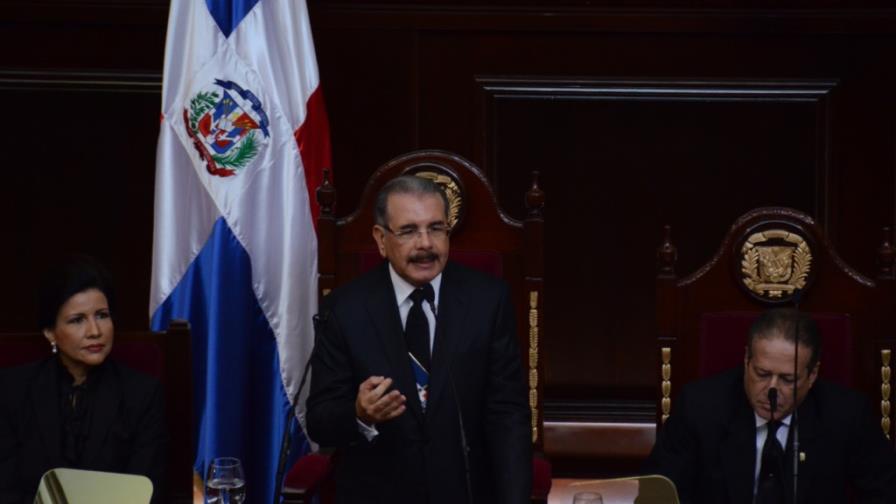
SD. After a year and six months since the start of his administration, President Danilo Medina announced that he would convene, before the end of 2014, a national pact for electricity with the mediation of the Economic and Social Council (CES).
The President made this announcement yesterday, 27 February, within the framework of his speech recounting the last year of his administration of the country to the National Assembly. He accompanied his speech with the great promise of resolving the eternal problem of the electric sector in the Dominican Republic.
The Electricity Pact was one of the promises made by President Medina during his inaugural speech on 16 August 2012.
"Once and for all we will leave behind this situation of high prices and deficient service," said the President, before he announced the implementation plans for the diversification of the energy matrix of the electric sector, reduce the losses, and improve the management of the electricity distributors. He calculated that these plans will provide a savings to the government and the country of between US$800 and US$900 million a year.
The executive referred to the tender, now finished, for the construction of two new, coal-based, generation plants of 380 megawatts each, which should save the country US$450 million on government transfers to the electricity sector. Both plants will be owned and operated by the state.
He also announced "solid advances" in the conversion to natural gas of the generators of the San Pedro de Macoris Electricity Company (formerly Cogentrix), which have a capacity of 300 megawatts.
Contributing to these advances is the expansion of the production of natural gas in the United States which "promises a unique occasion to lower generation costs," he said.
In this way, the President sees in the United States a potential market for the country to supply itself with natural gas that the new generation plants demand.
The infrastructure for natural gas in San Pedro de Macoris will include a floating terminal that investors from the private sector propose to build, and which is expected that it will have the capacity to supply 1000 megawatts. This project should be available by the second half of 2015. Medina estimated that these projects will generate a savings of US$100 million a year for the country.
This strategy of converting to natural gas could extend to other plants and spur the construction of new generation projects," the President stated.
Another project of interest for the government is the work on the finishing touches of the Combined Cycle generator which is being done by AES Dominicana, and that once it enters service will provide another 108 megawatts to the national system.
"This will be done by the AES Dominicana company, who are currently in the process of selecting a contractor. It is estimated that this project will be finished by the first half of 2016 and will produce savings of US$50 million a year," he revealed.
All told, these projects, together with others that are in the planning phase, "represent a radical evolution in the fuel matrix for generating electricity which will allow the channeling of the Dominican Republic towards the sustainable development of the electricity sector," the President forecast. Other projects currently underway and presented by the Executive have to do with the reparation of the electricity distribution lines that are going on with an investment of US$304 million.
A third axis that was stressed has to do with the efficiency of the service provided by the distribution companies. Regarding this, the President announced that as one result the gathering 130,000 new clients and an increase of more than 10% in the number of consumers that pay for their electricity.
Economic growth
The macro-economic indicators show a decidedly optimistic balance for 2013 and a perspective f the future really hopeful for 2014 which is going along well, said President Medina. He said that he expected that the tendency for growth will consolidate and that 2014 will end with a growth close to 5% of GDP "within a framework of financial stability."
"We committed ourselves to establish the basis of a development model that puts people, families and communities at the center of all of the policies," he reiterated as on other occasions.
The President made this announcement yesterday, 27 February, within the framework of his speech recounting the last year of his administration of the country to the National Assembly. He accompanied his speech with the great promise of resolving the eternal problem of the electric sector in the Dominican Republic.
The Electricity Pact was one of the promises made by President Medina during his inaugural speech on 16 August 2012.
"Once and for all we will leave behind this situation of high prices and deficient service," said the President, before he announced the implementation plans for the diversification of the energy matrix of the electric sector, reduce the losses, and improve the management of the electricity distributors. He calculated that these plans will provide a savings to the government and the country of between US$800 and US$900 million a year.
The executive referred to the tender, now finished, for the construction of two new, coal-based, generation plants of 380 megawatts each, which should save the country US$450 million on government transfers to the electricity sector. Both plants will be owned and operated by the state.
He also announced "solid advances" in the conversion to natural gas of the generators of the San Pedro de Macoris Electricity Company (formerly Cogentrix), which have a capacity of 300 megawatts.
Contributing to these advances is the expansion of the production of natural gas in the United States which "promises a unique occasion to lower generation costs," he said.
In this way, the President sees in the United States a potential market for the country to supply itself with natural gas that the new generation plants demand.
The infrastructure for natural gas in San Pedro de Macoris will include a floating terminal that investors from the private sector propose to build, and which is expected that it will have the capacity to supply 1000 megawatts. This project should be available by the second half of 2015. Medina estimated that these projects will generate a savings of US$100 million a year for the country.
This strategy of converting to natural gas could extend to other plants and spur the construction of new generation projects," the President stated.
Another project of interest for the government is the work on the finishing touches of the Combined Cycle generator which is being done by AES Dominicana, and that once it enters service will provide another 108 megawatts to the national system.
"This will be done by the AES Dominicana company, who are currently in the process of selecting a contractor. It is estimated that this project will be finished by the first half of 2016 and will produce savings of US$50 million a year," he revealed.
All told, these projects, together with others that are in the planning phase, "represent a radical evolution in the fuel matrix for generating electricity which will allow the channeling of the Dominican Republic towards the sustainable development of the electricity sector," the President forecast. Other projects currently underway and presented by the Executive have to do with the reparation of the electricity distribution lines that are going on with an investment of US$304 million.
A third axis that was stressed has to do with the efficiency of the service provided by the distribution companies. Regarding this, the President announced that as one result the gathering 130,000 new clients and an increase of more than 10% in the number of consumers that pay for their electricity.
Economic growth
The macro-economic indicators show a decidedly optimistic balance for 2013 and a perspective f the future really hopeful for 2014 which is going along well, said President Medina. He said that he expected that the tendency for growth will consolidate and that 2014 will end with a growth close to 5% of GDP "within a framework of financial stability."
"We committed ourselves to establish the basis of a development model that puts people, families and communities at the center of all of the policies," he reiterated as on other occasions.
 Edwin Ruiz

 Continuar con Google