


WIFI internet of the Ministry of Youth is a failure
 Diario Libre







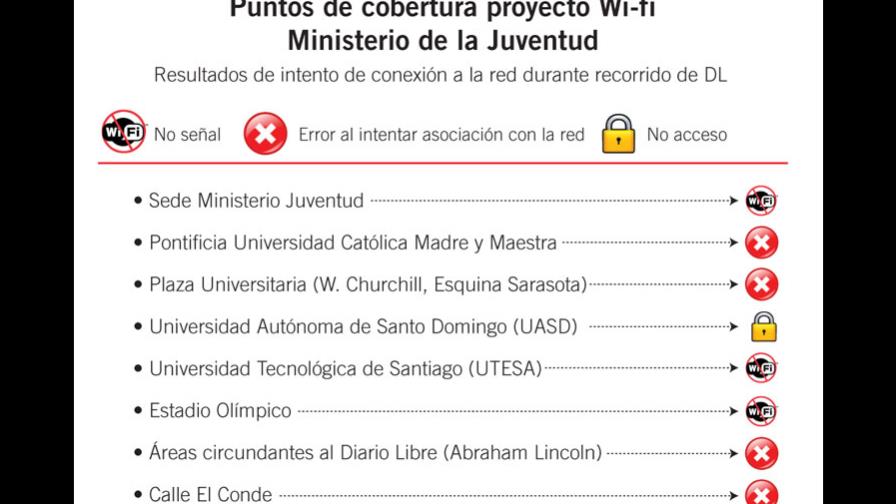
SD. There are places in the metropolitan area of the capital where users can receive a wireless internet signal (Wi-Fi) which says "Secretaria Juventud". But the network found by computers and smart-phones, after an investment of more than RD$70 million by the Ministry of Youth (MJ) for the start of a free public internet project in 2006, does not work.
And this was confirmed yesterday by a team of Diario Libre reporters who traveled to the 10 "hot spots" of Wi-Fi coverage announced in the first stage. One of these points was just outside the Ministry of Youth, where the network was not able to be picked up. In others, such as the Abraham Lincoln Avenue, the computers received a message of "error in trying to access network."
The head of the Youth Ministry, Franklin Rodriguez, has been postponing conversations with Diario Libre reporters. Briefly, he explained that they are trying to revamp the project with the support of institutions such as the Municipal Government of the National District, about which he would give details which this newspaper is still waiting to hear.
The idea, at the beginning, was within the framework of the Project to Reduce the Digital Gap which included: Free Internet Wi-Fi, Centers for Young Persons to get information, and the Program of Direct Assistance.
In the initial stages, the internet wi-fi had a reach of five kilometers from the Ministry of Youth. It would count on 256 repeaters (which would be placed by the government of the National District) distributed slowly and in a strategic manner in the National District, with a capacity to handle 17,000 users.
For students
According to what a description of the project "Wi-Fi" created by the Directorate of Information and Technology of the Deputy Secretary for Technology and Planning at the Ministry of Youth, the principle beneficiaries of the free Wi-Fi would be the student, especially those of the Autonomous University of Santo Domingo (UASD) since three of the antennas and 10 of the first repeaters were installed in the main campus.
A canvass carried out among students showed that at the present time the service is non-existent.
Gini Rosario, who works with the technology system at the UASD, explained to the Diario Libre that at the start in 2006, the public internet access worked with some limitations. "The bandwidth was very low," she said, and added that some pages were not accessible such as the social site that was in vogue at that time: Hi5.
Faced with the necessity of having public internet access for the student population, the student receive the signal from the Pedro Mir Library (Wi-Fi BPM) which allows limited access to certain sites, since it primary use for the internet use of the university.
This system also presents problems due to the breakdown of several pieces of equipment that repeat the Wi-Fi signal and for which the UASD has placed a tender for its repair.
Besides the state university, the students from the Santiago Technological University (UTESA) were included among the beneficiaries of the free signal, according to the project of the Ministry of Youth.
The second stage includes Wi-Fi for Santiago
The then Secretary of the Youth took on the Wi-Fi project as an institution and inaugurated it on 6 July 2006. The former director of the Dominican Institute of Telecommunications (Indotel), Jose Rafael Vargas, told Diario Libre that his agency did not take part in the project.
From the beginning, the then head of the Youth Ministry, Manuel Crespo, explained that it would have a central node that would be fed by a broadband internet feed that at the start would be about 6000 kbs. In the beginning it was supposed to work with a password but later it was left open to the public. In November 2006 it was announced that the project would extend to other areas of the capital and to Santiago.
There has been talk of a free internet project for the Santo Domingo Metro.
And this was confirmed yesterday by a team of Diario Libre reporters who traveled to the 10 "hot spots" of Wi-Fi coverage announced in the first stage. One of these points was just outside the Ministry of Youth, where the network was not able to be picked up. In others, such as the Abraham Lincoln Avenue, the computers received a message of "error in trying to access network."
The head of the Youth Ministry, Franklin Rodriguez, has been postponing conversations with Diario Libre reporters. Briefly, he explained that they are trying to revamp the project with the support of institutions such as the Municipal Government of the National District, about which he would give details which this newspaper is still waiting to hear.
The idea, at the beginning, was within the framework of the Project to Reduce the Digital Gap which included: Free Internet Wi-Fi, Centers for Young Persons to get information, and the Program of Direct Assistance.
In the initial stages, the internet wi-fi had a reach of five kilometers from the Ministry of Youth. It would count on 256 repeaters (which would be placed by the government of the National District) distributed slowly and in a strategic manner in the National District, with a capacity to handle 17,000 users.
For students
According to what a description of the project "Wi-Fi" created by the Directorate of Information and Technology of the Deputy Secretary for Technology and Planning at the Ministry of Youth, the principle beneficiaries of the free Wi-Fi would be the student, especially those of the Autonomous University of Santo Domingo (UASD) since three of the antennas and 10 of the first repeaters were installed in the main campus.
A canvass carried out among students showed that at the present time the service is non-existent.
Gini Rosario, who works with the technology system at the UASD, explained to the Diario Libre that at the start in 2006, the public internet access worked with some limitations. "The bandwidth was very low," she said, and added that some pages were not accessible such as the social site that was in vogue at that time: Hi5.
Faced with the necessity of having public internet access for the student population, the student receive the signal from the Pedro Mir Library (Wi-Fi BPM) which allows limited access to certain sites, since it primary use for the internet use of the university.
This system also presents problems due to the breakdown of several pieces of equipment that repeat the Wi-Fi signal and for which the UASD has placed a tender for its repair.
Besides the state university, the students from the Santiago Technological University (UTESA) were included among the beneficiaries of the free signal, according to the project of the Ministry of Youth.
The second stage includes Wi-Fi for Santiago
The then Secretary of the Youth took on the Wi-Fi project as an institution and inaugurated it on 6 July 2006. The former director of the Dominican Institute of Telecommunications (Indotel), Jose Rafael Vargas, told Diario Libre that his agency did not take part in the project.
From the beginning, the then head of the Youth Ministry, Manuel Crespo, explained that it would have a central node that would be fed by a broadband internet feed that at the start would be about 6000 kbs. In the beginning it was supposed to work with a password but later it was left open to the public. In November 2006 it was announced that the project would extend to other areas of the capital and to Santiago.
There has been talk of a free internet project for the Santo Domingo Metro.
 Diario Libre

 Continuar con Google